Vocabulary
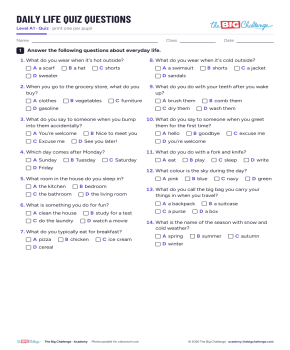
A printable multiple-choice quiz on everyday life: 14 questions, four options each. A diagnostic to run before or after the theme, not a test, about 30 minutes.
Your Worksheet
Assess your students' knowledge with this ready-to-use worksheet, designed to reinforce grammar and vocabulary points.
This resource is available for free. Simply create an account or log in to access it immediately.
Pedagogical Guide
Objective & content
Fourteen multiple-choice questions on the vocabulary of a normal day: this A1 quiz asks what you wear when it is hot (shorts), which day comes after Monday (Tuesday) and what you do with your teeth after you wake up (brush them). Pupils read the instruction, "Answer the following questions about everyday life", and pick one of four options each time. The topics are clothes, food, rooms, objects, colours, greetings, days and seasons. An answer-key page is included.
Pedagogical guide
Each question can be answered from one familiar word, so the quiz checks word-to-situation links rather than grammar. It is a quick diagnostic before or after a unit on daily life, not a test. Two items deserve a short discussion because a second option is defensible: a hat as well as shorts for hot weather, and a backpack as well as a suitcase for the big bag you carry when you travel. Let pupils argue their choice before you show the key.
Suggested procedure
- (5 min) Ask pupils what they wear in summer and in winter, to bring in the clothing words.
- (15 min) Pupils answer the fourteen questions alone and circle one option each.
- (7 min) Check with the key page and discuss the two items with a second possible answer.
- (3 min) Pupils write one new question of their own and read it to a partner.
Adaptations
[S] Read each question aloud, and let pupils point to the picture-friendly options first (clothes, food, rooms), then do the rest.
[A] Pupils turn five questions into full answers, for example "I wear shorts when it's hot outside.", and add one more item to each.
Materials & prerequisites
One printed sheet per pupil, a pencil and the key page. The sheet uses British spelling ("colour").