Vocabulary
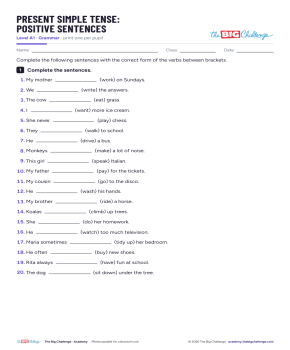
A printable A1 grammar sheet on the present simple in positive sentences: 20 gap-fill sentences with verbs in brackets, practising third-person -s and -es. About 30 minutes.
Your Worksheet
Assess your students' knowledge with this ready-to-use worksheet, designed to reinforce grammar and vocabulary points.
This resource is available for free. Simply create an account or log in to access it immediately.
Pedagogical Guide
Objective & content
Twenty positive sentences, one verb to fill in each: this A1 grammar sheet practises the present simple with items such as My mother ___ (work) on Sundays, He ___ (watch) too much television and Koalas ___ (climb) up trees. Pupils follow the instruction, "Complete the following sentences with the correct form of the verbs between brackets". The sheet contains positive sentences only (no negatives or questions) and has an answer-key page.
Pedagogical guide
The decision pupils face in every item is the same: does the subject take -s? With I, we, they and plural nouns (Koalas, Monkeys) the verb stays as it is; with he, she and singular nouns it takes -s, -es (washes, watches, goes, does), -ies (tidies up) or the irregular has. Frequency adverbs (never, sometimes, often, always) appear in some sentences. Use the sheet after the form has been presented orally, as written practice; it is not an introduction.
Suggested procedure
- (5 min) On the board, write I work and she works and ask pupils what changes. Do item 1 together.
- (15 min) Pupils complete the twenty sentences individually.
- (5 min) Pupils swap sheets and mark each other's work with the key page, circling every missing -s or -es.
- (5 min) Collect the verbs that changed spelling (goes, washes, tidies up) in a list on the board.
Adaptations
[S] Let pupils first do the five sentences with I, we, they and plural subjects, where the verb does not change, then the third-person ones.
[A] Pupils write five true sentences about their family with always, often or never.
Materials & prerequisites
One printed sheet per pupil, a pencil and the key page. Pupils should know the basic verbs and the pronouns I, he, she, we and they.