W skrócie
Poziom CEFR :A2
Poziom klasy :Level 3
Typ :Ćwiczenia i arkusze
Kultura i cywilizacja :Życie codzienne
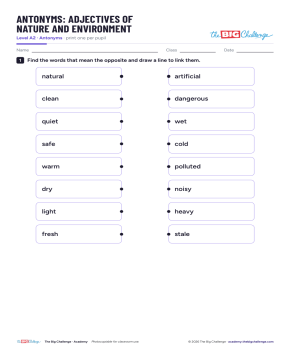
A printable A2 pairing worksheet on adjectives of nature and the environment: 8 words in each of two columns, to be joined to the word that means the opposite. Recognition practice that works both on the day the words are introduced and as later revision, in about 25 minutes.
Poziom CEFR :A2
Poziom klasy :Level 3
Typ :Ćwiczenia i arkusze
Kultura i cywilizacja :Życie codzienne
Sprawdź wiedzę swoich uczniów za pomocą gotowego do użycia arkusza ćwiczeń, zaprojektowanego w celu utrwalenia gramatyki i słownictwa.
To materiały premium, które są częścią The Big Challenge Academy. Wykup roczny abonament, aby uzyskać nieograniczony dostęp do setek zasobów premium.
Resource Objective & Content
The objective is to introduce and consolidate basic vocabulary for describing nature and environmental conditions by identifying and associating antonymous (opposite) adjectives.
The document is an exercise titled "Antonyms Game" for A2 level on the theme "Adjectives of Nature and Environment". Students must connect eight pairs of words with opposite meanings. The vocabulary covers environmental concepts (natural/artificial , clean/polluted , fresh/stale ), physical conditions (warm/cold , dry/wet , light/heavy ) and qualities of places (quiet/noisy , safe/dangerous ). This activity gives learners the tools to make simple comparisons about their environment.
Suggested Procedure
Before the activity (~5 min): THE WEATHER OF OPPOSITES
Start an oral warm-up on the weather using simple opposites. Ask: "Is it hot today? No, it's... cold!", "Is it wet outside? No, it's... dry!".
During the activity (~5-10 min): FIND THE OPPOSITES
Distribute the worksheet. Ensure that the instruction to find the opposite (the opposite) is well understood.
Do the first pair, for example warm/cold, all together.
Let students, alone or in pairs, connect the other pairs. Correct collectively using contrasting images (a forest/quiet and a city/noisy).
After the activity (~10 min): DESCRIBE THE PICTURE
Show a simple image of a place (e.g., a clean beach, a polluted street).
Ask closed questions that prompt the adjectives from the worksheet as answers. For example: "Is this place quiet or noisy?", "Is the water clean or polluted?".
Adaptations
To simplify: Use gestures and sounds to illustrate concepts before starting: shiver for cold, make a loud noise for noisy, etc.
To extend: Ask students to draw two opposite scenes (e.g., a sunny and dry day vs. a rainy and wet day) and label them with at least two pairs of antonyms from the worksheet.
Please wait...