W skrócie
Poziom CEFR :A2
Poziom klasy :Level 3
Typ :Ćwiczenia i arkusze
Kultura i cywilizacja :Życie codzienne
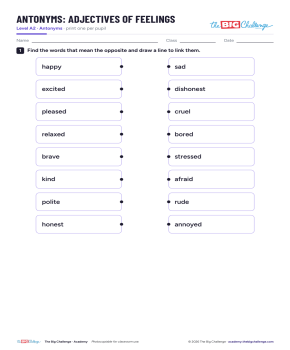
A printable A2 pairing worksheet on adjectives of feeling: 8 words in each of two columns, to be joined to the word that means the opposite. Recognition practice that works both on the day the words are introduced and as later revision, in about 25 minutes.
Poziom CEFR :A2
Poziom klasy :Level 3
Typ :Ćwiczenia i arkusze
Kultura i cywilizacja :Życie codzienne
Sprawdź wiedzę swoich uczniów za pomocą gotowego do użycia arkusza ćwiczeń, zaprojektowanego w celu utrwalenia gramatyki i słownictwa.
Te materiały są dostępne bezpłatnie. Wystarczy utworzyć konto lub zalogować się, aby uzyskać natychmiastowy dostęp.
Resource Objective & Content
The objective is to introduce and consolidate basic vocabulary for describing feelings and emotions by identifying and associating antonym (opposite) adjectives.
The document is an exercise titled "Antonyms Game" for A2 level on the theme "Adjectives of Feelings". Students must connect eight pairs of words with opposite meanings. The vocabulary covers fundamental emotions and character traits: happy/sad, excited/bored, pleased/annoyed, relaxed/stressed, brave/afraid, kind/cruel, polite/rude, and honest/dishonest. This activity gives learners the words to express simple positive and negative feelings.
Suggested Procedure
Before the activity (~5 min): THE EMOTICON GAME
Show simple emoticons (😊, 😠, 😥) and ask students to name the emotion in English. Then, ask: "What is the opposite?" to introduce the concept of opposites.
During the activity (~5-10 min): FINDING THE OPPOSITES
Distribute the worksheet. Make sure the instruction to find the opposite (the opposite) is well understood.
Do the first, most obvious pair (happy/sad) together as a class.
Let students, individually or in pairs, connect the other pairs. Correct collectively using facial expressions to reinforce the meaning of the words.
After the activity (~10 min): HOW DO YOU FEEL?
Give students simple situations and ask them how they would feel.
For example: "It's your birthday! How do you feel?" (I feel happy / excited!). "You lost your book. How do you feel?" (I feel sad / annoyed.).
Adaptations
To simplify: Before the exercise, draw two large faces on the board (one happy, one unhappy). Classify all the adjectives from the worksheet into these two categories with the help of the class to then facilitate the association of opposites.
To extend: Ask students to draw a face expressing an emotion from the worksheet, then write a simple sentence below it, such as: "I feel brave.".
Please wait...