W skrócie
Poziom CEFR :B1
Poziom klasy :Level 5
Typ :Ćwiczenia i arkusze
Kultura i cywilizacja :Życie codzienne
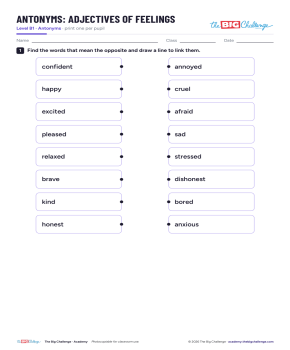
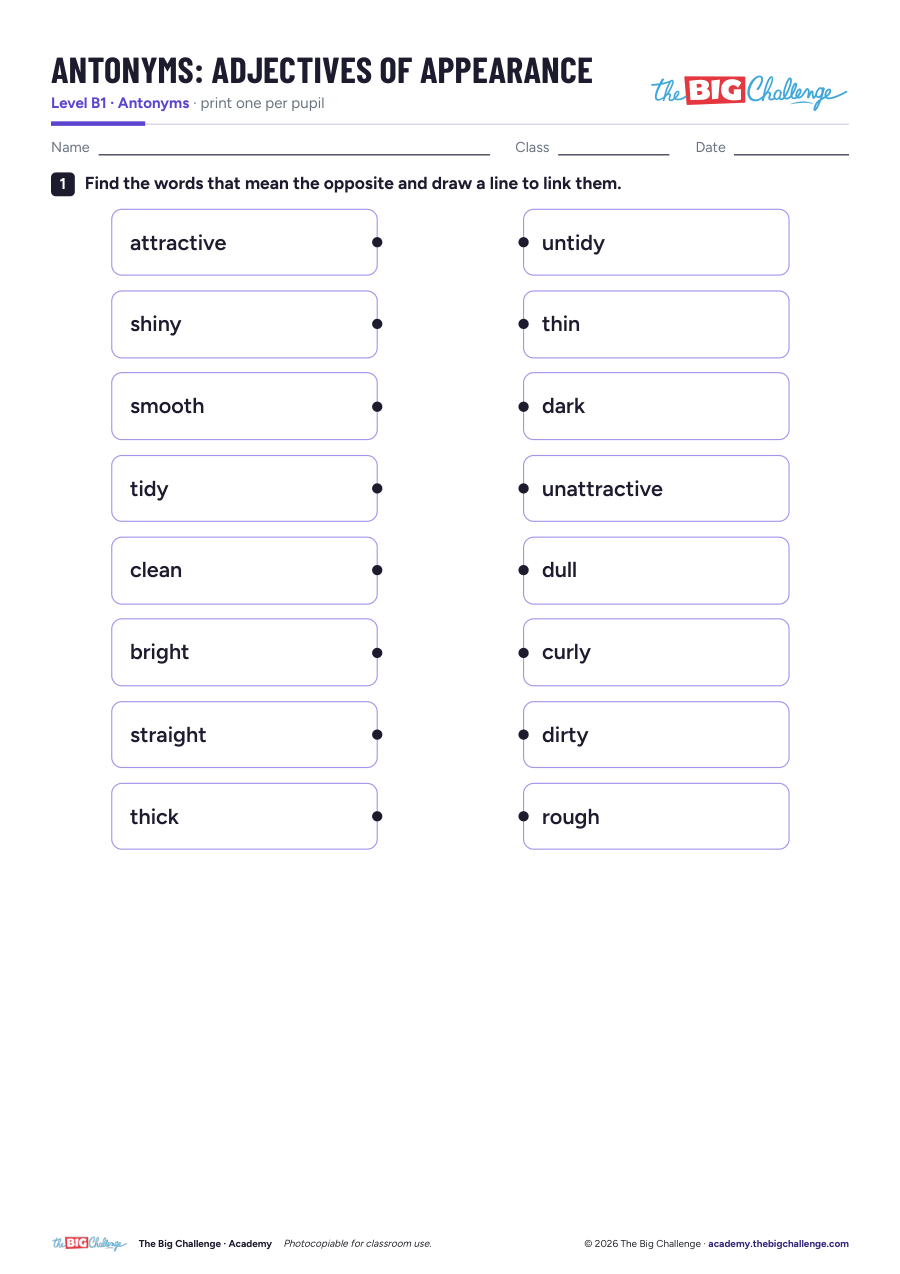
A printable B1 pairing worksheet on adjectives of feeling: 8 words in each of two columns, to be joined to the word that means the opposite. Recognition practice that works both on the day the words are introduced and as later revision, in about 25 minutes.
Poziom CEFR :B1
Poziom klasy :Level 5
Typ :Ćwiczenia i arkusze
Kultura i cywilizacja :Życie codzienne
Sprawdź wiedzę swoich uczniów za pomocą gotowego do użycia arkusza ćwiczeń, zaprojektowanego w celu utrwalenia gramatyki i słownictwa.
Te materiały są dostępne bezpłatnie. Wystarczy utworzyć konto lub zalogować się, aby uzyskać natychmiastowy dostęp.
Objective & Resource Content
The objective is to consolidate and expand students' vocabulary for describing feelings and emotions by identifying and associating antonymous (opposite) adjectives.
The document is an exercise titled "Antonyms Game" on the theme "Adjectives of Feelings". Students must connect eight pairs of words with opposite meanings. The vocabulary covers a wide spectrum of emotions: joy (happy/sad, excited/bored, pleased/annoyed), serenity (confident/anxious, relaxed/stressed), courage (brave/afraid) and character (kind/cruel, honest/dishonest). This activity helps students better understand emotions by thinking about them in contrasting pairs.
Suggested Procedure
Before the activity (~5 min): THE EMOTICON BAROMETER
Project or draw a few emoticons on the board (e.g.: 😊, 😡, 😢, 😨). Ask students to give as many English adjectives as possible to describe each emotion.
During the activity (~5-10 min): FINDING THE OPPOSITES
Distribute the worksheet. Remind them to look for the opposite (the opposite).
Let students, individually or in pairs, connect the antonym pairs.
Lead a collective correction by asking students to mime or make a facial expression corresponding to certain adjectives to check comprehension.
After the activity (~10 min): MINI-SCENARIOS
Give students simple situations (ex: "You have a big exam tomorrow", "You are going to a party").
In pairs, one student expresses their feeling with an adjective from the worksheet (ex: "I'm so excited!"), and their classmate responds using the antonym or by asking a question (ex: "Why aren't you bored?").
Adaptations
To simplify: Before the matching exercise, create two columns on the board: "Positive Feelings" and "Negative Feelings". Classify all the adjectives from the worksheet together. This will greatly facilitate finding the pairs.
To deepen: Ask students to create a short dialogue between two characters who feel opposite emotions in the same situation (ex: watching a horror movie, one is excited, the other is afraid).
Please wait...