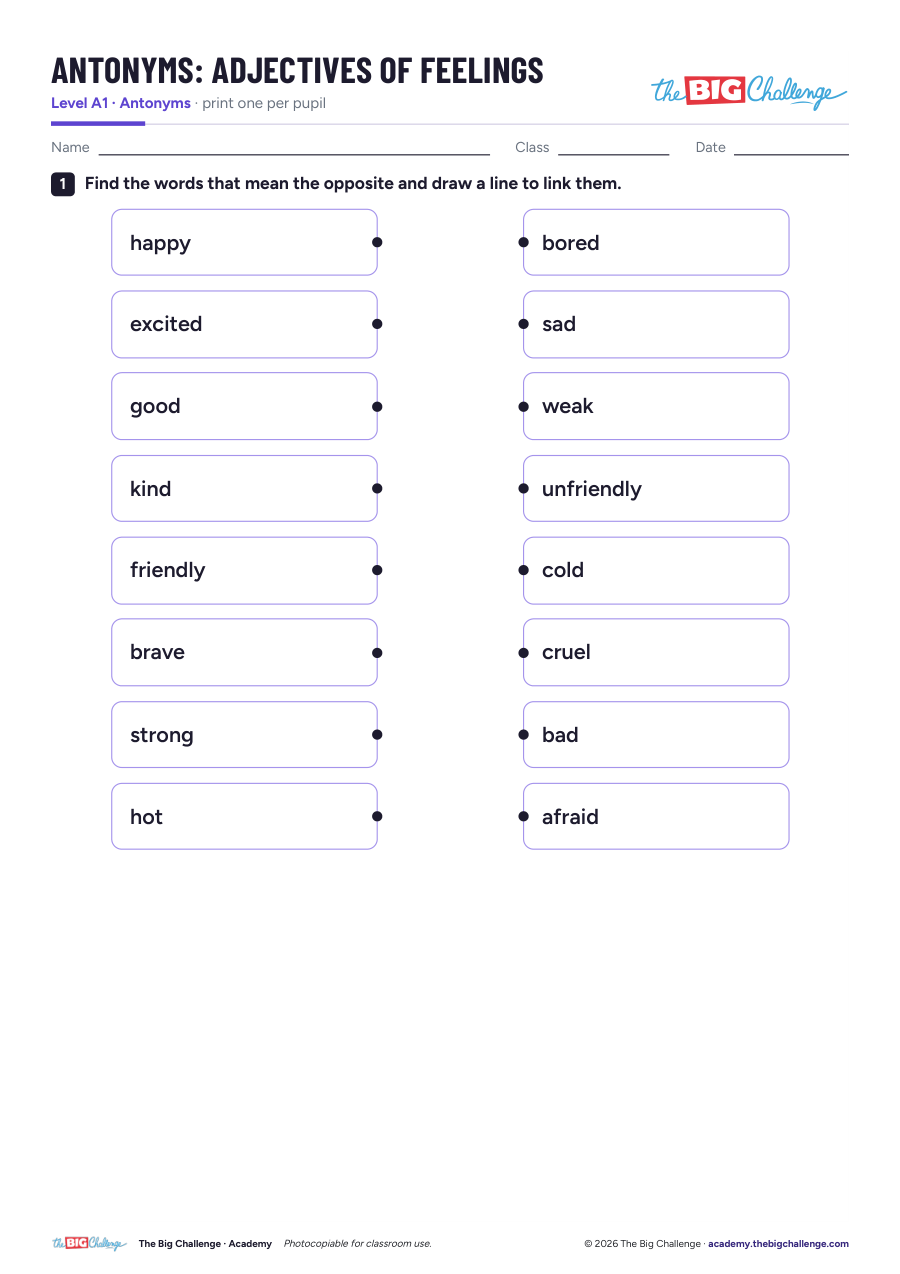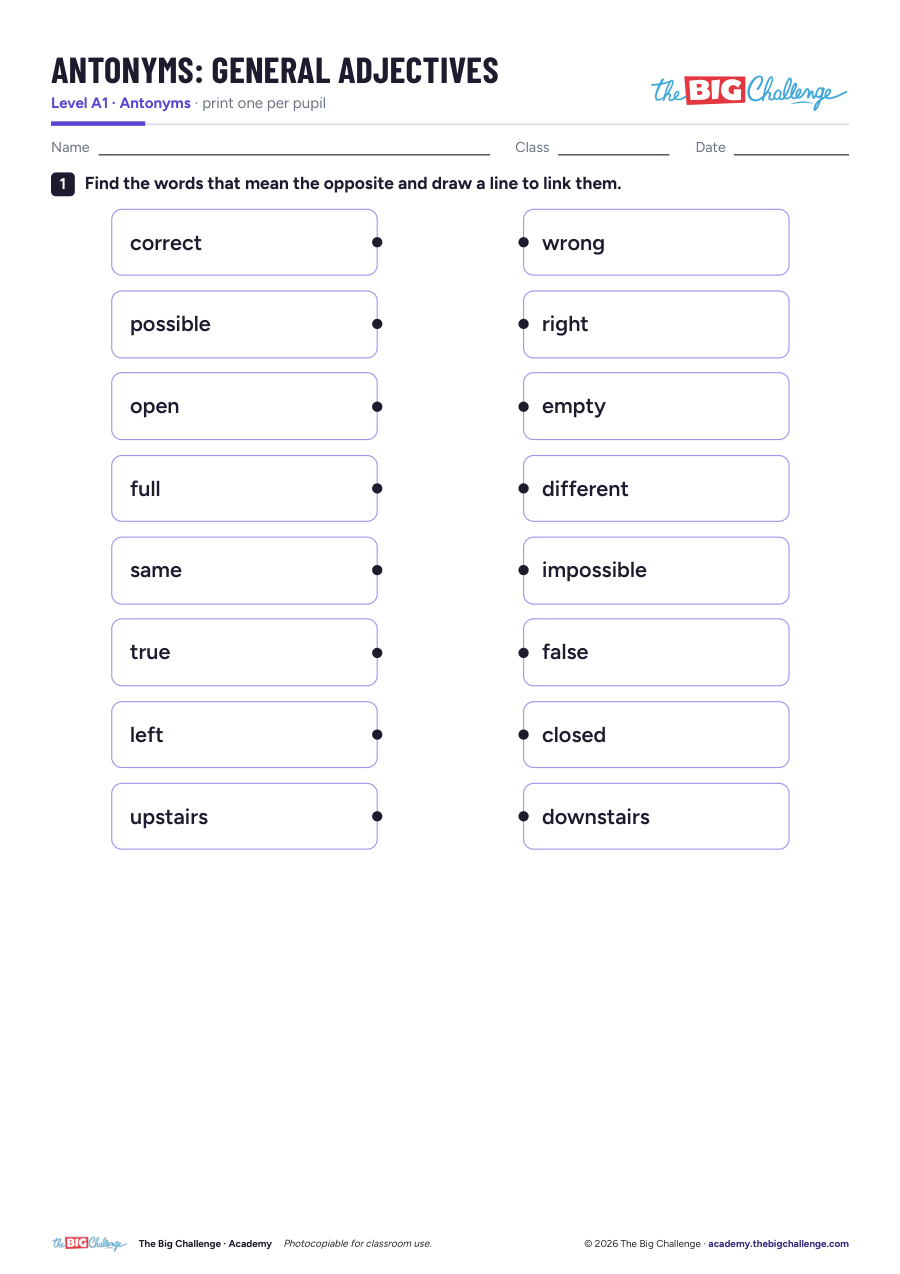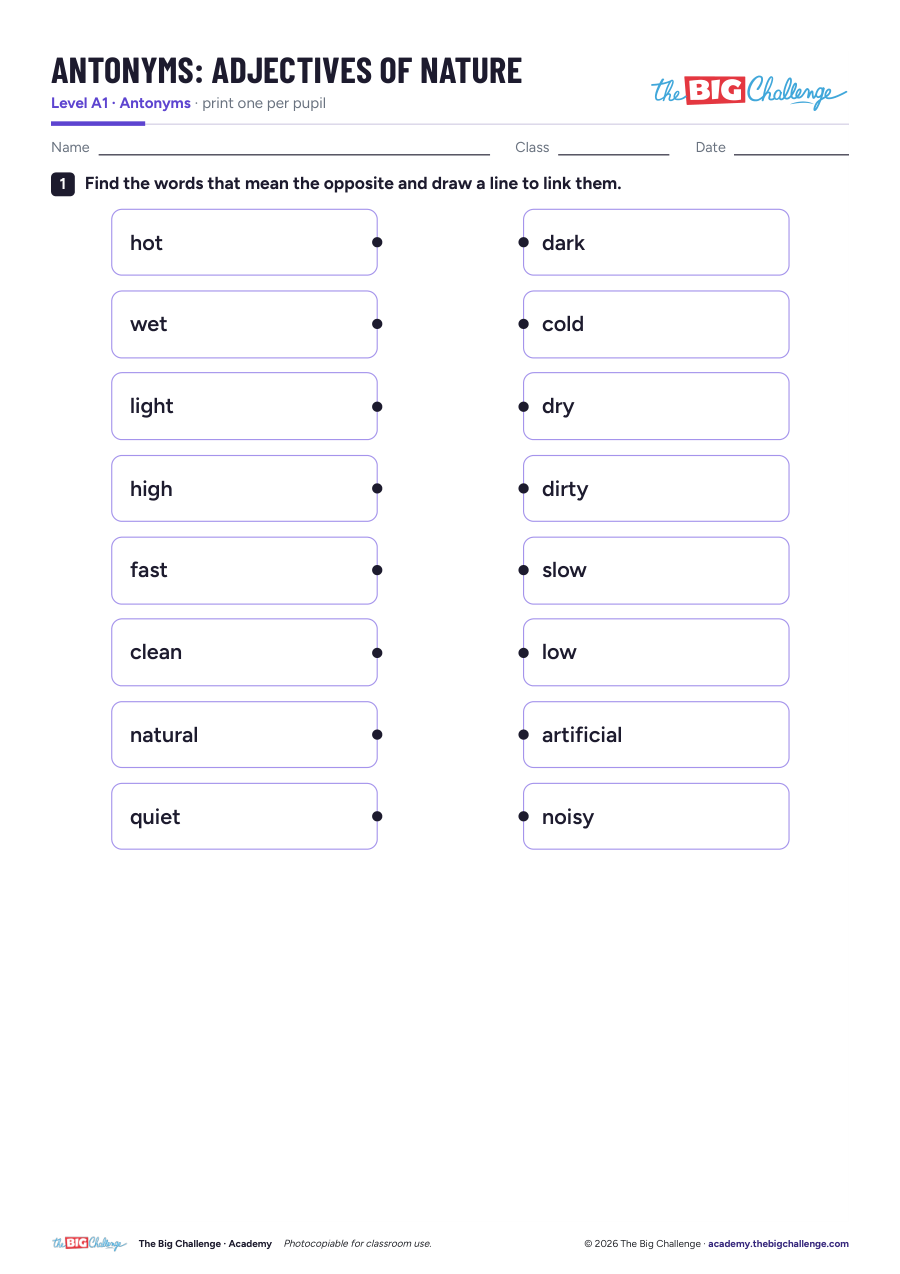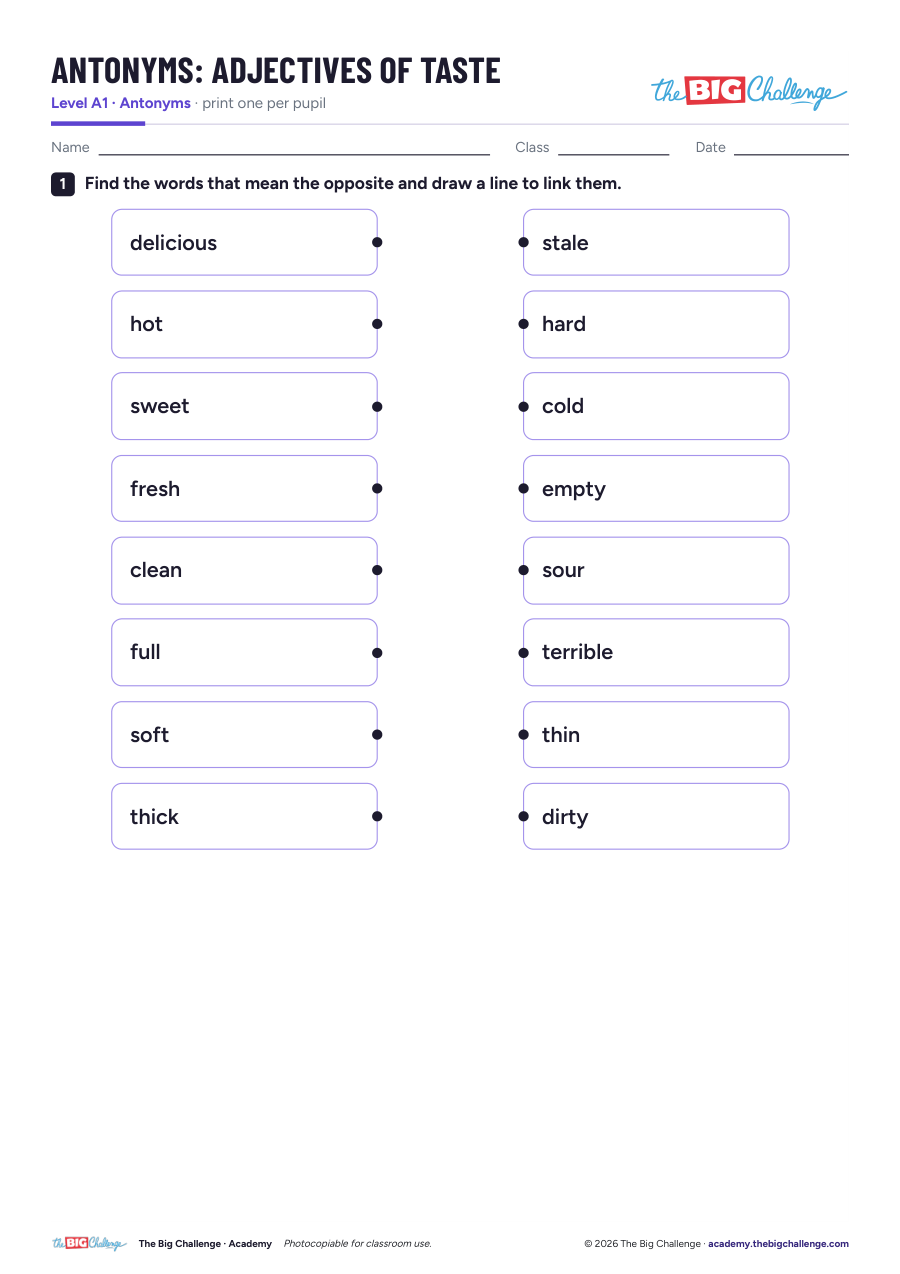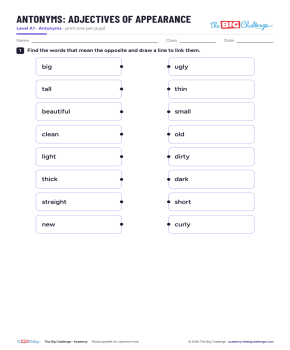
Adjectives of Appearance
Conteúdo ExclusivoA printable A1 pairing worksheet on adjectives of appearance: 8 words in each of two columns, to be joined to the word that means the opposite. Recognition practice that works both on the day the words are introduced and as later revision, in about 25 minutes.
Sua folha de exercícios
Avalie o conhecimento dos seus alunos com esta folha de exercícios pronta para usar, projetada para reforçar pontos gramaticais e de vocabulário.
Este recurso está disponível gratuitamente. Basta criar uma conta ou fazer login para acessá-lo imediatamente.
Guia Pedagógico
Resource Objective & Content
The objective is to introduce the concept of opposites (antonyms) with basic descriptive vocabulary to very young learners (A1 level).
The document is an exercise titled "Antonyms Game" for A1 level on the theme "Adjectives of Appearance". Students must connect eight pairs of words with opposite meanings. The vocabulary consists of some of the most common descriptive adjectives: big/small, tall/short, beautiful/ugly, clean/dirty, light/dark, thick/thin, straight/curly, and new/old. This activity builds the very first foundations of descriptive vocabulary.
Suggested Procedure
Before the activity (~5 min): SHOW ME!
-
Use Total Physical Response (TPR). Say "big" and make a big circle with your arms. Say "small" and bring your hands together. Do the same for tall and short by standing up and squatting down.
During the activity (~5 min): LET'S FIND THE OPPOSITES TOGETHER
-
Distribute the worksheet. Complete the exercise in a fully guided manner with the class.
-
For each word on the left, say it aloud, have students repeat it, then together find its opposite on the right. Use simple drawings on the board to illustrate each pair (e.g., a clean t-shirt and a dirty t-shirt).
After the activity (~5 min): SHOW ME SOMETHING...
-
Give very simple instructions using the vocabulary from the worksheet. For example: "Point to something big in the classroom.", "Point to something clean.".
-
Students should simply point to the corresponding object.
Adaptations
-
To simplify: As the activity is already very simple, the main adaptation is to use as many real objects, mimes, and images as possible for each word even before looking at the worksheet.
-
To extend: Play "Jacques a dit" (Simon Says) using the vocabulary. For example: "Simon says, show me something new.", "Simon says, make a tall body.".