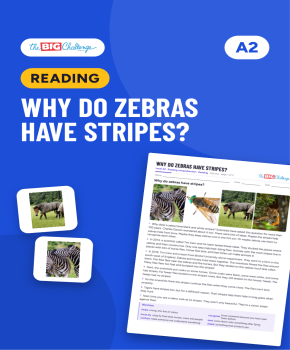
Reading A2: Why Do Zebras Have Stripes?
Academy Access
Your Worksheet
Assess your students' knowledge with this ready-to-use worksheet, designed to reinforce grammar and vocabulary points.
Premium Resource. This tool is part of The Big Challenge Academy. Subscribe for unlimited access to hundreds of premium resources.
Pedagogical Guide
Objective & content
An A2 reading about a question scientists have asked for more than 100 years: why do zebras have stripes? The text gives the old ideas (hiding from lions, keeping cool, recognising each other), then tells how scientists tested them. In 2014, Tim Caro and his team found that animals with the most stripes live in places with lots of biting horse flies. In 2019, on a farm in England, his team filmed flies around zebras and horses, then put black, white and striped coats on horses: far fewer flies landed on the stripes, but they still landed on the horses' heads. The text adds that tigers have stripes for a different reason, to hide when they hunt, and ends on the stripes as a clever shield against flies. By the end, pupils can follow a short text about an experiment, find facts and give reasons. It is part of the Reading A2 set: one-text readings with the same layout.
Pedagogical guide
The sheet has one text of about 270 words at A2, with short sentences of 13 words or fewer, and a word box with six words explained in English (stripe, recognise, horse fly, land, confuse, shield). The ten questions go from finding information to giving reasons: three choices, true or false and one gap to complete first, then "Why did the flies still land on the horses' heads? Explain using the text." and "Think of another animal with interesting colours. What do you think they are for?" The experiment is told in the past simple (tested, went, filmed, landed, bumped); ideas come with "maybe", and the result with "so". The speaking task puts this to work: in groups, pupils choose an animal (a polar bear, a flamingo, a ladybird or a chameleon) and decide why it has its colours. Every fact comes from published research on zebra stripes.
Suggested procedure
- (5 min) Warm-up: show the photos and ask "Why do you think these animals have stripes?"
- (10 min) Pupils read the text alone. They can use the word box.
- (10 min) Pupils answer questions 1 to 10, then check in pairs. Correct together with the key; for 9 and 10, take two or three answers.
- (10 to 15 min) Speaking task: in groups, pupils choose an animal, find two ideas about why it has its colours, choose the best one with "Maybe it helps the animal to ..." and "We think it has ... because ...", then tell the class.
Adaptations
[S] Go through the word box first, with the photos. Before question 9, read paragraph 4 again together. Pupils can answer questions 1 to 8 only, and give one idea in the speaking task.
[A] Pupils plan their own experiment to test their idea about the animal's colours, in three steps, and present it to the class. They can also find out why flamingos are pink.
Materials & prerequisites
The sheet in colour or low ink (the low-ink version has no pictures), one copy per pupil: pages 1 and 2 are for pupils, page 3 is the answer key. A screen to show the photos for the warm-up. Pupils should know the past simple, regular and irregular.