


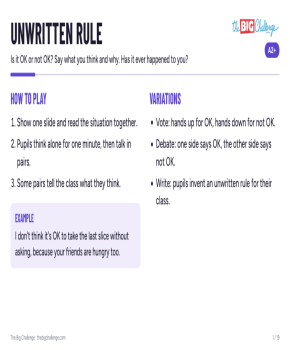
Unwritten rule
Academy Access
It's Time to Play!
Learning while having fun is the best method! Launch this interactive game for a fun and motivating review session.
Premium Resource. This tool is part of The Big Challenge Academy. Subscribe for unlimited access to hundreds of premium resources.
Pedagogical Guide
Objective & content
By the end, A2+ pupils can give an opinion on an everyday situation with a reason, using should / shouldn't, I think / I don't think and It depends. If .... The bank is 19 projectable slides: a how-to slide, then 18 pictured situations from the life of pupils aged 11 to 15, such as taking the last slice of pizza without asking or looking at a phone during dinner. Pupils say if each one is OK or not OK, and why.
Pedagogical guide
Use it as a five-minute speaking warm-up. Every slide asks the same question, so the routine is quickly familiar and the energy goes into the opinion. The useful-language box on every situation slide gives each pupil a way in, and the closing question (Has it ever happened to you?) invites a short personal story. There is no right answer: welcome "It depends" and ask for the reason. The slides are interchangeable: show one or two per lesson.
Suggested procedure
- (1 min) Show the how-to slide and read the example together.
- (1 min) Show one situation and read it and its sentence starters aloud. Pupils think alone.
- (2 min) Pupils talk in pairs: OK or not OK, and why.
- (1 min) Two or three pairs tell the class what they think.
Adaptations
- [S] Vote first (hands up for OK, hands down for not OK), then ask for one reason.
- [A] Debate: one side says OK, the other says not OK. Or pupils write an unwritten rule for their class.
Materials & prerequisites
A projector or screen; the bank is a 16:9 PDF, one slide per page, with no printing needed. Assumes should / shouldn't, because, and Have you ever ...? in the present perfect.
Curriculum alignment
Maps to Cycle 3 "child and close environment" and Cycle 4 "encountering others" (FR): talking about life with friends and family, and comparing points of view.