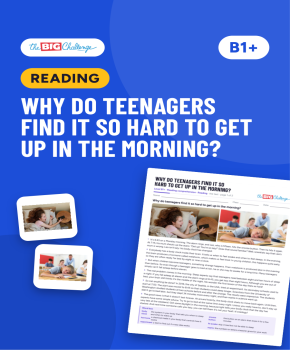
Reading B1+: Why Do Teenagers Find It So Hard to Get Up in the Morning?
Academy Access
Your Worksheet
Assess your students' knowledge with this ready-to-use worksheet, designed to reinforce grammar and vocabulary points.
Premium Resource. This tool is part of The Big Challenge Academy. Subscribe for unlimited access to hundreds of premium resources.
Pedagogical Guide
Objective & content
A B1+ reading that answers a question every teenager has asked: why is it so hard to get up in the morning? The text starts with Leo, 15, hitting the snooze button while his mum calls him lazy, then explains what scientists have found: in the teenage years, the brain produces melatonin, the hormone that makes us sleepy, later in the evening, so teenagers can't fall asleep early but still need eight to ten hours of sleep. It then tells what happened when secondary schools in Seattle started at 8:45 instead of 7:50 (34 minutes more sleep a night, and better marks in science), and ends with some simple advice and a smile: "it's not your fault: it's biology!" By the end, pupils can follow a short popular-science text, find details and explain a cause in their own words, and give an opinion in a debate. It is part of the Reading B1+ set: one-text readings with the same layout.
Pedagogical guide
The sheet has one text of about 390 words at B1+, with no sentence longer than 20 words, and a word box with six words explained in English (body clock, snooze button, hormone, lie awake, experiment, marks). The ten questions go from finding information to explaining it: three choices or true or false first, then "Find two results of the Seattle experiment" and "Why does the first lesson of the day often feel hard for teenagers? Answer in your own words." The text uses the B1+ linkers although, even though, so that and unless, the passive (is produced, was moved) and used to, so it works well after a lesson on linkers or the passive. The speaking task is a class debate, "Should school start at 10 o'clock?", with three sentence starters that use the same linkers. Every fact in the text comes from published sleep research. The tone is light and reassuring: nothing about screens or bad habits.
Suggested procedure
- (5 min) Warm-up: show the two photos and ask "What's happening here? How do they feel? What time do you get up?"
- (10 min) Pupils read the text alone. They can use the word box.
- (10 min) Pupils answer questions 1 to 10, then check in pairs. Correct together with the key; for 9 and 10, take two or three answers.
- (10 to 15 min) Debate: "Should school start at 10 o'clock?" In groups, pupils find two reasons for and two against, using the sentence starters. Each group gives its best reason, then the class votes.
Adaptations
[S] Read the first two paragraphs aloud together before pupils read alone, and go through the word box first. Pupils can answer questions 1 to 8 only, and give one reason in the debate with a sentence starter.
[A] Pupils write a short paragraph after the debate: "Should school start later? Give your opinion with although, so that and unless." They can also find the passive sentences in the text and say who does the action.
Materials & prerequisites
The sheet in colour or low ink (the low-ink version has no pictures), one copy per pupil: pages 1 and 2 are for pupils, page 3 is the answer key. A screen to show the photos for the warm-up. Pupils should know the present perfect and because, so and but.