


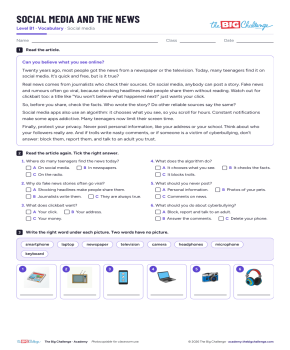
Social media and the news
Academy Access
Your Worksheet
Assess your students' knowledge with this ready-to-use worksheet, designed to reinforce grammar and vocabulary points.
Premium Resource. This tool is part of The Big Challenge Academy. Subscribe for unlimited access to hundreds of premium resources.
Pedagogical Guide
Objective & content
This sheet on social media and the news opens on an article for teenagers, "Can you believe what you see online?". It explains where real news comes from, why fake news and rumours go viral, how clickbait and algorithms keep you scrolling, and how to protect your privacy and deal with trolls and cyberbullying. The article carries all the target words in context, from headlines, journalists and sources to go viral, clickbait, algorithm, privacy and report. By the end, pupils understand and use the words to talk about how they get the news, how to spot fake news and how to stay safe online.
Pedagogical guide
The vocabulary work comes out of the article, never from a list. Page 1 checks understanding with six multiple-choice questions, then pupils write the right word under six pictures of media and devices (newspaper, laptop, headphones); two words in the box have no picture. Page 2 matches eight words with their meanings (a source, a rumour, to go viral, a troll) and six collocations (check the facts, protect your privacy, talk to an adult you trust). Page 3 uses eight words from a box of ten in new sentences, with two extra words, turns verbs into adjectives with -ive (addict, addictive), with a worked example and five items, and ends on a mystery word: eight clues from the article, and the first letters spell FAKE NEWS. It is the hardest task, as pupils find each word from its clue alone. Every task tests words, never grammar.
Suggested procedure
- (5 min) Ask pupils where they saw their last piece of news; write the words they know on the board.
- (15 min) Pupils read the article, answer the six questions and label the pictures.
- (10 min) Page 2: match the meanings, then the collocations.
- (15 min) Page 3: complete the eight sentences, the adjectives with -ive, then the mystery word.
- (10 min) Correct with the answer key on pages 4 and 5; ask pupils which tip from the article they will use.
Adaptations
[S] Read the article aloud together first; ask pupils where they saw their last piece of news.
[A] After the collocations, pupils write three tips for staying safe online.
Materials & prerequisites
One copy per pupil of the three pupil pages, in colour or black and white. Pages 4 and 5 are the answer key with teacher notes: keep them. Pupils should know the present simple, the imperative, if clauses, relative clauses with who, and can and should. To take it further, pupils check a viral story in pairs and present how they found out if it was true.