


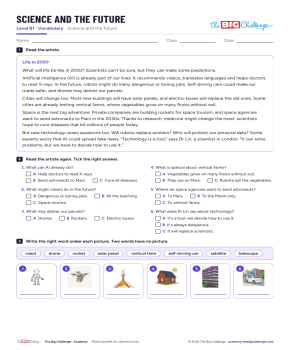
Science and the future
Academy Access
Your Worksheet
Assess your students' knowledge with this ready-to-use worksheet, designed to reinforce grammar and vocabulary points.
Premium Resource. This tool is part of The Big Challenge Academy. Subscribe for unlimited access to hundreds of premium resources.
Pedagogical Guide
Objective & content
This sheet on science and the future opens on a science magazine article, "Life in 2050". Artificial intelligence already recommends videos, translates languages and helps doctors read X-rays; in the future, robots might do dangerous or boring jobs, drones may deliver our parcels, vertical farms grow vegetables without soil, and space agencies want to send astronauts to Mars in the 2030s. The article ends on the questions new technology raises, about jobs, personal data and fake news. It carries all the target words in context, from predictions, artificial intelligence and self-driving to research, cure, data and tool. By the end, pupils understand and use the words to make predictions about the future ("Robots will...", "AI might...") and to discuss the good and bad sides of new technology.
Pedagogical guide
The vocabulary work comes out of the article, never from a list. Page 1 checks understanding with six multiple-choice questions, then pupils write the right word under six pictures from a box of eight (robot, drone, solar panel, vertical farm); two words have no picture. Page 2 matches eight words with their meanings (a prediction, artificial intelligence, soil, to cure) and six collocations (make a prediction, do research, protect your data). Page 3 uses eight words from a box of ten in new sentences, with two extra words, and makes adjectives with -less from nouns (wire, wireless), with a worked example and five items. It ends on a crossword: ten clues from the article, with no word box, give words such as drones, soil, research and predictions. Every task tests words, never grammar.
Suggested procedure
- (5 min) Ask pupils for one thing they think will change by 2050; write their ideas on the board.
- (15 min) Pupils read the article, answer the six questions and label the pictures.
- (10 min) Page 2: match the meanings, then the collocations.
- (15 min) Page 3: complete the eight sentences, the adjectives with -less, then the crossword.
- (10 min) Correct with the answer key on pages 4 and 5; pupils read the crossword clues aloud with their answers.
Adaptations
[S] Read the article aloud together first; ask pupils for one thing they think will change by 2050.
[A] After the collocations, pupils write five predictions for their own town in 2050.
Materials & prerequisites
One copy per pupil of the three pupil pages, in colour or black and white. Pages 4 and 5 are the answer key with teacher notes: keep them. Pupils should know will, might, may and could for predictions, the present continuous for projects happening now, the first conditional and relative clauses with where. To take it further, hold a class debate, "Will robots replace teachers?".