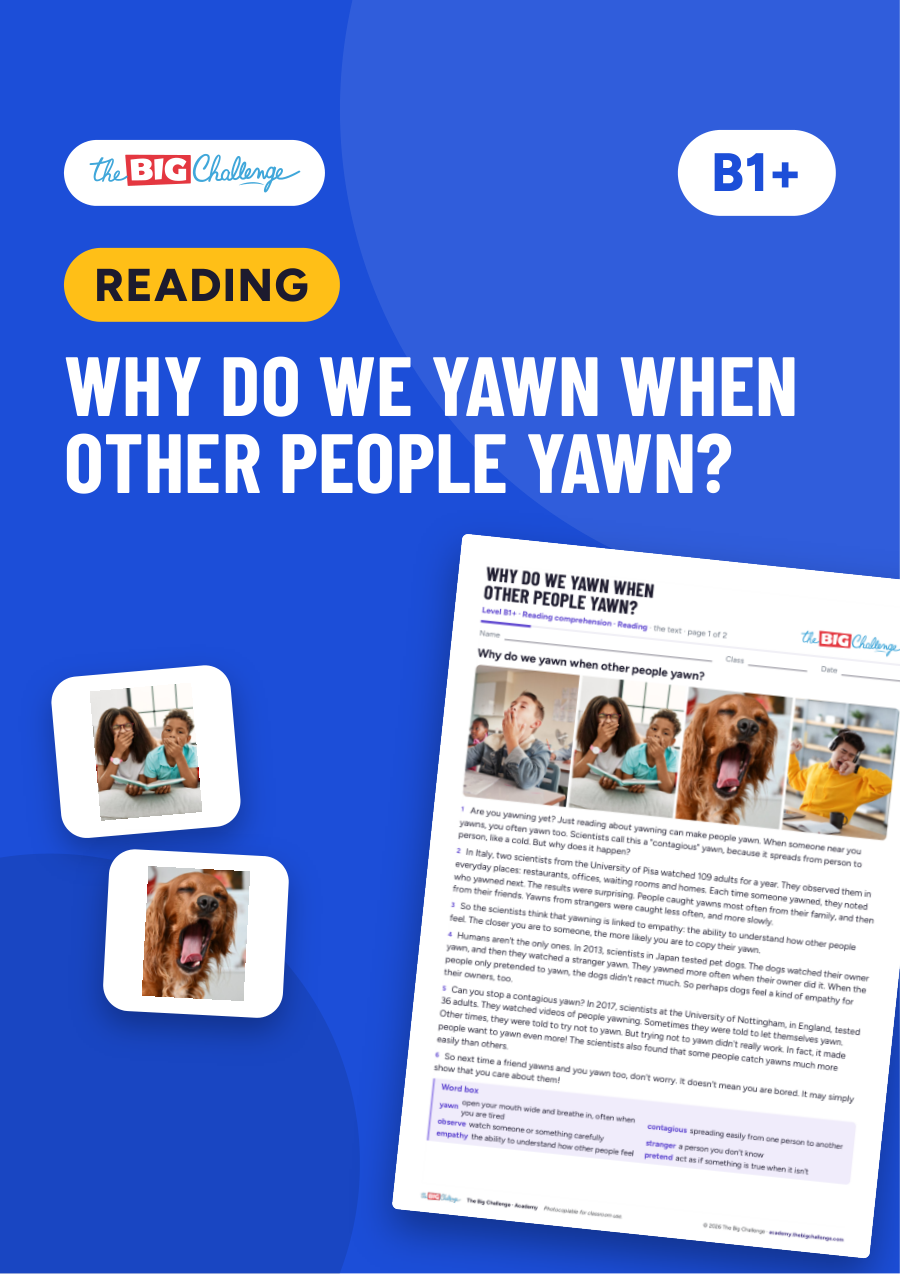
Reading B1+: Why Do Teenagers Take More Risks When Their Friends Are Watching?
Academy Access
Your Worksheet
Assess your students' knowledge with this ready-to-use worksheet, designed to reinforce grammar and vocabulary points.
Premium Resource. This tool is part of The Big Challenge Academy. Subscribe for unlimited access to hundreds of premium resources.
Pedagogical Guide
Objective & content
A B1+ reading about something every teenager knows: with friends watching, you do things you would never do alone. The text presents three studies. At Temple University, in a driving game, teenagers and adults played the same way alone, but only the teenagers took more risks when their friends were watching: the part of the brain that feels rewards was more active. At the Science Museum in London, young teenagers listened more to other teenagers' opinions than to adults'. A last study shows the good side: with friends watching, young people also learned faster from their mistakes. The text ends with a question to ask yourself: "Would I do this if I was alone?" By the end, pupils can follow a short popular-science text, explain a result, and discuss influence with reasons. It is part of the Reading B1+ set: one-text readings with the same layout.
Pedagogical guide
The sheet has one text of about 350 words at B1+, with no sentence longer than 20 words, and a word box with six words explained in English (risk, sensible, reward, scan, opinion, influence). The ten questions go from finding information to explaining it: three choices or true or false first, then "Why do friends make risks more attractive for teenagers? Explain using the text." and "Can you think of a time when your friends made you braver, or more careful?" The text models the passive (the teenagers were told, the players' brains were scanned, these opinions were invented by a computer) and "more likely to". The speaking task adds the second conditional: "If I was alone, I would ...". Every fact comes from published research on teenagers and their friends.
Suggested procedure
- (5 min) Warm-up: show the three photos and ask "Would you do this alone? Or only with your friends?"
- (10 min) Pupils read the text alone. They can use the word box.
- (10 min) Pupils answer questions 1 to 10, then check in pairs. Correct together with the key; for 9 and 10, take two or three answers.
- (10 to 15 min) Speaking task: in groups, pupils think of two situations where friends push someone to take a risk and two where friends help someone, decide whether each one is a good or a bad influence, then tell the class.
Adaptations
[S] Go through the word box first. Before question 9, read paragraph 4 again together. Pupils can answer questions 1 to 8 only, and give one situation in the speaking task.
[A] Pupils write a short paragraph, "A time my friends influenced me", with two sentences in the second conditional. They can also design their own experiment on friends and risk, without any danger.
Materials & prerequisites
The sheet in colour or low ink (the low-ink version has no pictures), one copy per pupil: pages 1 and 2 are for pupils, page 3 is the answer key. A screen to show the photos for the warm-up. Pupils should know the past simple and have met the passive and the second conditional.