


Secret Code
Academy Access
Your Worksheet
Assess your students' knowledge with this ready-to-use worksheet, designed to reinforce grammar and vocabulary points.
Premium Resource. This tool is part of The Big Challenge Academy. Subscribe for unlimited access to hundreds of premium resources.
Pedagogical Guide
Objective & content
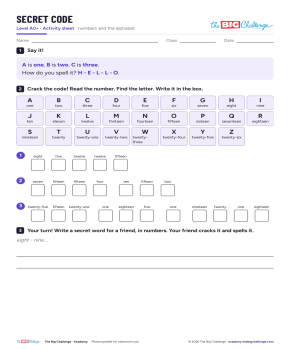
In this activity sheet, pupils crack a secret code where every letter of the alphabet is a number written in words: A is one, B is two, and so on up to Z, twenty-six. They read each number word, find its letter in the code, write it in a box and spell the message aloud. The three messages are HELLO, GOOD JOB and YOU ARE A STAR. By the end, pupils read the numbers 1 to 26 in words, know the alphabet and spell words aloud in English.
Pedagogical guide
The code is written in words, not digits, so every letter pupils find means reading an English number. The Say it! box at the top models the language of the whole activity: A is one. B is two. and How do you spell it? H - E - L - L - O. The three messages get longer, from one short word to a whole sentence, so pupils speed up as they learn the code. Spelling each answer aloud turns a reading puzzle into speaking practice with letter names. The last task swaps the roles: each pupil writes a secret word in number words for a friend, who cracks it and spells it aloud. Page 2 is the answer key with teacher notes.
Suggested procedure
- (5 min) Sing or say the alphabet together, then count to twenty-six as a class.
- (5 min) Read the Say it! box together and show the code: A is one, B is two.
- (15 min) Pupils crack the three messages; when they finish one, they spell it aloud ("H-E-L-L-O!").
- (10 min) Each pupil writes a secret word for a friend in number words; friends swap, crack it and spell it aloud.
- (5 min) Check the three messages with the answer key on page 2.
Adaptations
[S] Crack message 1 together on the board before pupils work alone.
[A] Pupils write a whole secret sentence for a friend, not just one word.
Materials & prerequisites
One copy of page 1 per pupil, in colour or black and white, and a pencil. Page 2 is the answer key with teacher notes: keep it. Pupils should know some letter names and be able to count to ten in English; the code on the sheet gives them every number word up to twenty-six.