


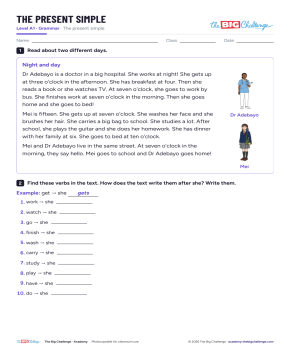
The present simple
Academy Access
Your Worksheet
Assess your students' knowledge with this ready-to-use worksheet, designed to reinforce grammar and vocabulary points.
Premium Resource. This tool is part of The Big Challenge Academy. Subscribe for unlimited access to hundreds of premium resources.
Pedagogical Guide
Objective & content
This grammar sheet teaches the present simple to say what people do every day, with a focus on the he / she form and its spelling: works, watches, goes, studies, has, does. Pupils read about two people's days, find the verbs, then read the rule, given in a box, and use it. By the end, they can say what someone does every day and choose between live and lives by looking at the subject.
Pedagogical guide
Page 1 has two short texts: Dr Adebayo, a doctor who works at night, and Mei, a pupil of fifteen. They live in the same street and say hello at seven in the morning, when one goes to school and the other goes home. Pupils find ten verbs in the texts and write the she form. Page 2: pupils read the rule, given in a box in short lines with the key words in bold, then choose the right form in thirteen sentences, where the subject decides (My friends play, Our teacher goes). Page 3 has twelve verbs to write with -s, -es or -ies (washes, studies, flies), then "A day with Biscuit", a family's cat: sixteen brackets with three choices each, such as wakes / wake / waking, each settled by its subject. Every exercise opens with a worked example. Negatives and questions (don't, doesn't, do, does) are not on the sheet.
Suggested procedure
- (5 min) Tell the class three things you do every day ("I get up at seven."); ask a few pupils "And you?"
- (10 min) Read the two texts aloud; pupils find the verbs and write the she forms.
- (5 min) Read the rule in the box with the class; pupils find examples of it in the texts.
- (8 min) Pupils choose the right verb in the thirteen sentences.
- (8 min) Page 3: pupils write the verbs with -s, -es or -ies.
- (8 min) Pupils read about Biscuit and circle the right words.
- (5 min) Check with the answer key on page 4.
Adaptations
[S] Read the texts aloud and ask the class to clap at every -s; pupils do the -s, -es or -ies exercise in pairs.
[A] Pupils write five sentences about the day of someone in their family ("My dad gets up at six.").
Materials & prerequisites
One copy of pages 1 to 3 per pupil. Page 4 is the answer key, with the teacher notes at the end of page 4 and on page 5: keep them. Pupils need the subject pronouns and the time with o'clock. To take it further, pupils write Biscuit's night, or their own pet's day, and read it to a partner.