


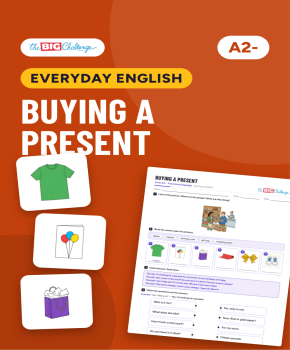
Buying a present
Academy Access
Your Worksheet
Assess your students' knowledge with this ready-to-use worksheet, designed to reinforce grammar and vocabulary points.
Premium Resource. This tool is part of The Big Challenge Academy. Subscribe for unlimited access to hundreds of premium resources.
Pedagogical Guide
Objective & content
A two-page pack for one everyday situation: choosing and buying a birthday present in a shop. Pupils learn the words (T-shirt, birthday card, gift bag, wrapping paper, ribbon, trainers) and the phrases to say what they want (I'm looking for a present for my friend. She likes music.), ask about it (How much is this scarf? Do you have it in blue? Can you wrap it, please?) and understand the answers (It's in the sale. This one is cheaper.). Then they hear the same language in a real conversation, the Listen Up! episode "Buying a present", and use it themselves in a role-play. By the end, they can choose a present in a shop, compare prices and ask the shop assistant for help.
Pedagogical guide
Page 1 is the language of the situation. Pupils talk about a picture of two teenage friends choosing a present in a gift shop, write six words under new drawings (the first is done), read a box of useful phrases (what you say or ask, and what you hear), and match five questions to their answers. Page 2 puts the language to work. Pupils complete a short dialogue with words from a box (Maria, who is buying a present for her friend Leo), then listen to the episode: Hannah and her friend Kofi choose a birthday T-shirt for her brother, with only twenty pounds. A QR code on the sheet plays the recording on a phone or a tablet, with no app and no login. Pupils tick true or false, listen again for four short answers, then do a role-play with A and B cards: a customer looks for a present for their grandad in a gift shop. Card B holds the information card A needs, so pupils have to ask. Every task opens with an example. Page 1 and the dialogue use other names, places and prices, so they never give away a listening answer. Page 3 is the answer key with the teacher notes.
Suggested procedure
- (5 min) Pupils look at the picture on page 1 and say where the people are and what they are doing.
- (5 min) Pupils write the words under the pictures; check together.
- (5 min) Pupils read the useful phrases aloud in pairs, one asking and one answering.
- (5 min) Pupils match the questions to the answers.
- (5 min) Page 2: pupils complete the dialogue with the words in the box.
- (10 min) Play the episode once for true or false, then again for the short answers.
- (10 min) Role-play in pairs with card A and card B, then pupils swap cards.
- (5 min) Check the answers with page 3.
Adaptations
[S] Pupils read the useful phrases aloud in pairs before the role-play, and keep page 1 in front of them while they play it. [A] Pupils invent their own problem in the same place and act it out without the cards.
Materials & prerequisites
One copy of pages 1 and 2 per pupil; cut out the role cards on page 2. Page 3 is the answer key: keep it. To play the episode, pupils scan the QR code with a phone or a tablet, or you play it to the class from the app (Listen Up!, "Buying a present"). Pupils need clothes, colours and prices, and short comparatives (cheaper, bigger).