


Name three!
Academy Access
It's Time to Play!
Learning while having fun is the best method! Launch this interactive game for a fun and motivating review session.
Premium Resource. This tool is part of The Big Challenge Academy. Subscribe for unlimited access to hundreds of premium resources.
Pedagogical Guide
Objective & content
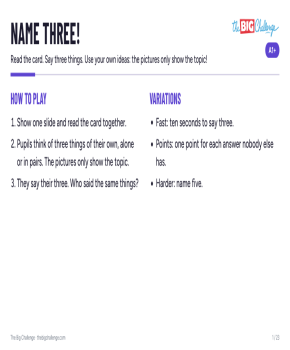
By the end, A1+ pupils can name three things in a familiar category and compare their answers with My three are ..., ... and ..., Me too! and I've got a different one: .... The bank is 23 projectable slides: a how-to slide, then 22 category cards, each with two scene pictures and three empty slots, from Things in a classroom to Food for a birthday party. Pupils score one point for each thing nobody else says. The pictures only show the topic: pupils use their own ideas, not what the pictures show.
Pedagogical guide
Use it as a five-minute warm-up or to revise vocabulary at the end of a topic. Every pupil can name one or two things, so the whole class takes part, and the scoring rewards less obvious words: a pupil who says calculator rather than pencil is more likely to score. The cards cover school, food, animals, clothes, home, free time and festivals, and they are interchangeable: show one or two per lesson.
Suggested procedure
- (1 min) Show the how-to slide, then one card, and read it together.
- (1 min) Pupils think of three things, alone or in pairs.
- (2 min) Pupils say their three with My three are .... The class reacts with Me too! or I've got a different one: ....
- (1 min) Count the points: one for each thing nobody else said.
Adaptations
- [S] Work in pairs, or find one example together first.
- [A] Name five things, or say three in ten seconds.
Materials & prerequisites
A projector or screen; the bank is a 16:9 PDF, one slide per page, with no printing needed. Assumes plurals and have got, and basic words for school, food, animals and clothes.
Curriculum alignment
Maps to Cycle 3 "child and close environment" (FR): naming the things of everyday life at school, at home and in free time.