


Might and have to
Academy Access
Your Worksheet
Assess your students' knowledge with this ready-to-use worksheet, designed to reinforce grammar and vocabulary points.
Premium Resource. This tool is part of The Big Challenge Academy. Subscribe for unlimited access to hundreds of premium resources.
Pedagogical Guide
Objective & content
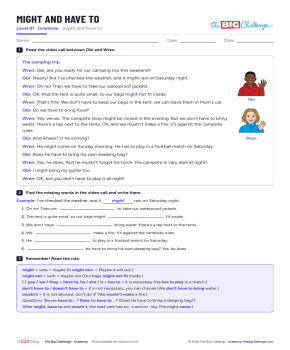
This grammar sheet teaches might and might not for what is possible (It might rain.), have to and has to for what is necessary, don't have to and doesn't have to for what is not necessary, and mustn't for what is not allowed, with questions (Do we have to ...? Does he have to ...?) and short answers. Pupils read a video call in which Obi and Wren plan a camping trip, find the missing words and read the rule, given in a box. By the end, they can say what might happen and what people have to do, don't have to do and mustn't do.
Pedagogical guide
Page 1 is the video call, with a picture of Obi and of Wren: it might rain on Saturday night, so they have to take their waterproof jackets; they don't have to bring water, because there is a tap next to the tents, but they mustn't make a fire; their friend Anwar might come on Sunday morning, because he has to play in a football match on Saturday. Pupils find six missing words in sentences from the video call. Then they read the rule, given in a box in short lines with the key words in bold: might and might not, have to and has to, don't have to and doesn't have to ("it is not necessary, you can choose"), mustn't ("it is not allowed"), questions with Do and Does, and no -s or -ing on the next verb. Page 2 has eight sentences where the context decides between two forms (might or might not, has to or doesn't have to, mustn't or don't have to, Do or Does), six sentences to complete with the right form of have to, four Maybe ... will sentences to say again with might or might not, and four questions about the video call to answer with short answers. Page 3 is a mystery word: pupils say seven sentences again with might or have to and write the missing word in the boxes; the shaded letters answer the question "What might Obi and Wren see from the tent at night?". Then pupils write about a camping trip of their own. Every exercise opens with a worked example, except the mystery word and the writing task.
Suggested procedure
- (5 min) Tell the class "It might rain tomorrow, so I have to take an umbrella" and write the verbs on the board.
- (10 min) Read the video call aloud; pupils find the missing words.
- (5 min) Read the rule in the box with the class; pupils find an example of each line in the video call.
- (15 min) Page 2: pupils tick the right words, write the right form of have to, change the Maybe sentences and give the short answers.
- (10 min) Page 3: the mystery word, then the camping trip.
- (5 min) Check with the answer key on page 4.
Adaptations
[S] Pupils read the video call aloud in pairs, one as Obi and one as Wren, before the tasks.
[A] Pupils write three rules for their school with have to, don't have to and mustn't.
Materials & prerequisites
One copy of pages 1 to 3 per pupil. Page 4 is the answer key and teacher notes: keep it. The key accepts contracted and full forms (don't or do not). Pupils need the present simple with do and does, must and mustn't, can, and the words for holidays, the weather and school. To take it further, groups plan a class trip and write a list: things they have to bring, things they don't have to bring, things they mustn't do, and what the weather might do.