


Always or never?
Academy Access
Your Worksheet
Assess your students' knowledge with this ready-to-use worksheet, designed to reinforce grammar and vocabulary points.
Premium Resource. This tool is part of The Big Challenge Academy. Subscribe for unlimited access to hundreds of premium resources.
Pedagogical Guide
Objective & content
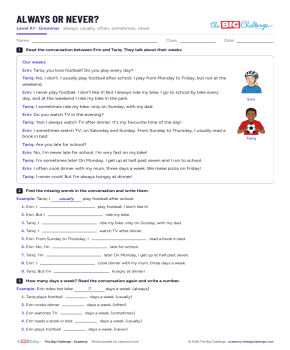
This grammar sheet teaches always, usually, often, sometimes and never with the present simple, and their place in the sentence: before the main verb (I always ride my bike.) and after be (I'm never late.). Pupils read a conversation in which Erin and Tariq compare their weeks, find the missing words and read the rule, given in a box. By the end, they can talk about their week and say what they always, sometimes or never do.
Pedagogical guide
Page 1 is the conversation, with a picture of Erin and of Tariq: Tariq plays football after school from Monday to Friday, and Erin goes to school by bike every day and is never late. Pupils find nine missing words in sentences from the conversation, then read it again and write how many days a week each word means (five sentences). Page 2 has the rule, given in a box in short lines with the key words in bold: a scale from always (7 days out of 7) through usually (5 or 6), often (3 or
- and sometimes (1 or 2) to never (0), then the place of the word, before the verb or after am, is or are. Pupils tick the right word in eight sentences from the number of days, then tick the right sentence in eight pairs where only the place of the word changes. Page 3 has five sentences to write again with the word in brackets, five sentences of free writing about their own week (one with each word, starting from I always ...), and Ivy's week: a chart with ticks for eight activities from Monday to Sunday. Pupils count the ticks and write the word and the verb for each activity (seven sentences). Every exercise opens with a worked example, except the free writing.
Suggested procedure
- (5 min) Ask "Do you play football every day? Do you watch TV every day?" and draw a line from 0 to 7 days on the board.
- (10 min) Read the conversation aloud; pupils find the missing words.
- (5 min) Pupils read the conversation again and count the days.
- (5 min) Read the rule in the box with the class; pupils place the five words on the line on the board.
- (10 min) Page 2: pupils tick the right words, then the right sentences.
- (10 min) Page 3: pupils write the sentences with the word in brackets, then write about their own week.
- (5 min) Ivy's week: pupils count the ticks and write the sentences.
- (5 min) Check with the answer key on page 4.
Adaptations
[S] Pupils read the conversation aloud in pairs, one as Erin and one as Tariq, before the tasks.
[A] Pupils ask a partner "Do you ... every day?" and report the answers with always, usually, often, sometimes or never.
Materials & prerequisites
One copy of pages 1 to 3 per pupil. Page 4 is the answer key and teacher notes: keep it. The sentences about the pupils' own week have no key: answers vary. Pupils need the present simple with he or she (the -s), am, is and are, the days of the week, and the words for the day, sports and food. To take it further, pupils draw a chart of their own week, swap it with a partner and write sentences about the partner's week.