


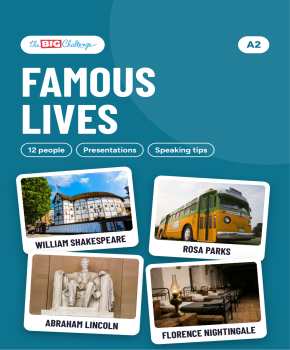
Famous lives
Academy Access
It's Time to Play!
Learning while having fun is the best method! Launch this interactive game for a fun and motivating review session.
Premium Resource. This tool is part of The Big Challenge Academy. Subscribe for unlimited access to hundreds of premium resources.
Pedagogical Guide
Objective & content
A presentation pack for A2 classes: twelve famous lives from the English-speaking world (William Shakespeare, Jane Austen, Isaac Newton, Charles Darwin, Florence Nightingale, Mary Seacole, Abraham Lincoln, Rosa Parks, Amelia Earhart, Charlie Chaplin, Walt Disney and Nelson Mandela). Every card has the same parts: at a glance (born, where, job), a life story in four dated moments, why we remember them and a surprising fact, with a photo of a place or thing from the story. Two people share a page: print 6 pages and cut them in half. Each pupil or group tells the story of one person to classmates who have not read it. By the end, pupils can tell a short life story in order in the past simple and pick out facts and dates when they listen.
Pedagogical guide
This is the step up from the A1 fact files: pupils no longer describe, they tell a story. The language is the past simple, regular and irregular (She married, he went, he became, she wrote), was / were, dates and ages (in 1932, when he was 22) and sequencing words (first, then, after that, in the end). Six women and six men, from England, Jamaica, the USA and South Africa, all no longer alive. Hard moments of history (slavery, segregation, apartheid) are told simply and factually. The speaking tips page gives a three-part talk (My person is ... He/She was born in ... / First, ... Then, ... After that, ... In the end, ... / We remember him/her because ... Thank you! Any questions?), five useful phrases and five tips, including drawing a timeline. The listening grid asks for one thing each person did and the year.
Suggested procedure
One lesson of about 50 minutes.
- (5 min) Show the cover and ask which people pupils know. Cut the card pages in half and give one person to each pupil or group.
- (10 min) Pupils read their card and prepare a one-minute talk with the speaking tips page. They draw a timeline and write key words on a card.
- (25 min) Each group tells its person's story. The class listens and writes one thing the person did and the year in the listening grid.
- (10 min) Pupils answer "Who would you like to meet? Why?" with "I'd like to meet ... because ..." and the class votes.
Adaptations
[S] Pupils tell only the at a glance part and two moments of the life story, reading from their timeline.
[A] Pupils add one more fact they find themselves, or the class puts all twelve people on one timeline on the board, from Shakespeare to Mandela.
Materials & prerequisites
Print factfiles.pdf: the 6 card pages (pages 1 to 6, two people a page, cut in half along the dashed line) so each pupil or group has one person, the speaking tips page (page 7) and the listening grid (page 8) for everyone; page 9 is the teacher page. Pupils should know the past simple of common verbs and how to say years. It goes well with work on biographies or history, and follows the A1 City, Animal and Festival fact files.