


Coming to America, Explained
Academy Access
A two-voice illustrated explainer of the great migration to America, from the 1840s to the 1920s. In five short episodes of about six minutes, the two hosts, Alex (American) and Sam (British), talk as equals and each brings their own country's view: why millions left Europe, how they crossed the ocean, the two doors of Ellis Island and Angel Island, whether America was welcoming, and who stayed and who came next. Each episode answers one question and ends on a surprise.
Explore the Multimedia Series
Access a complete pack of varied activities (videos, exercises, audio) for a rich and interactive teaching sequence.
Premium Resource. This tool is part of The Big Challenge Academy. Subscribe for unlimited access to hundreds of premium resources.
Pedagogical Guide
Objective & content
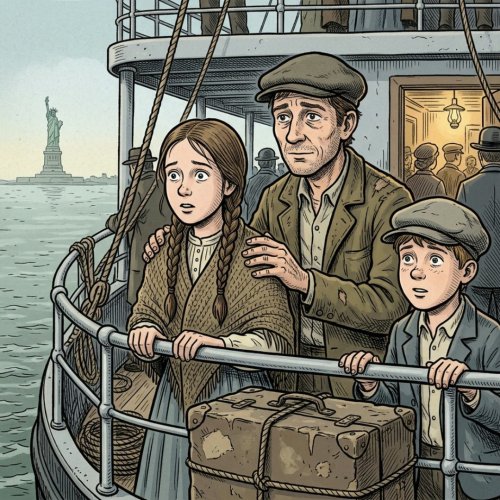
Coming to America, Explained is an illustrated audio series about the great migration to the United States, from the 1840s to the 1920s, told by two hosts: Alex, who is American, and Sam, who is British. They talk as equals, and each brings their own country's view of the same story. Each of the five episodes lasts about six minutes, is illustrated in a hand-inked comic style, and answers one question: Why did millions leave Europe? How did they get there? What happened at the two doors, Ellis Island in New York and Angel Island in San Francisco? Was America welcoming? Did they stay, and who came next? The story meets real places and real people (Annie Moore, the first person through Ellis Island; the poet Emma Lazarus), and the laws that closed the door (1882, 1917, 1924) are told as facts, with their dates and numbers. The five episodes are at A2+, and each ends on a surprise.
Pedagogical guide
Every episode opens with the theme tune, a hello and the story so far, and ends with what comes next, so pupils can follow the series in order or take one episode alone. The language work is the past simple for history and the grammar of explaining: because, so and but, could and had to for rules in the past, comparing, and questions with did, How much and How many. Each episode has an 18-question quiz in the app (facts, words and grammar), and the app shows English subtitles. Around each episode there is a one-page class pack with an answer key, a two-sided worksheet, a 45-minute lesson plan and its own teacher page. The two hosts are equals, so a class can compare with its own country: many of our pupils' families have their own stories of leaving and arriving, to share only if they wish. The history is told in broad strokes and kept factual, and the hard parts (hunger, the Chinese Exclusion Act, the quotas) are said briefly and calmly.
Suggested procedure
- Choose the episode and write its question on the board; pupils guess the answer.
- Pupils listen to the whole episode once, then check their guesses.
- They listen a second time, with a few pauses for short questions.
- They answer the quiz in the app: facts, then words, then grammar.
- In class, use the one-page pack or the worksheet, or follow the 45-minute lesson plan on the episode's page.
- In pairs, pupils play the two hosts and explain the episode's question in their own words.
- Play the next episode when the class is ready: the story goes from the 1840s to the 1920s.
