


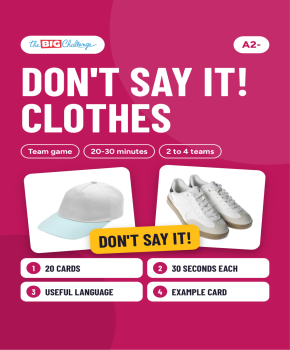
Don't say it! Clothes
Academy Access
It's Time to Play!
Learning while having fun is the best method! Launch this interactive game for a fun and motivating review session.
Premium Resource. This tool is part of The Big Challenge Academy. Subscribe for unlimited access to hundreds of premium resources.
Pedagogical Guide
Objective & content
Don't say it! Clothes is a projected team describing game, with photos, for one game of 20 to 30 minutes. One pupil describes the clothes word on the screen without saying the word or its three red words, and a teammate who stands with their back to the screen guesses it. The deck has a How to play slide with a useful language box, an example card with a model description, 20 cards (hat, jeans, jumper, T-shirt, socks, scarf, coat, trainers, shoes, shorts, skirt, dress, cap, sunglasses, belt, watch, shirt, hoodie, raincoat, flip-flops) and a "Who won?" slide. Pupils practise describing a thing by where and when you wear it and what it looks like, and asking "Is it a ...? Are they ...?".
Pedagogical guide
The three red words on each card are the easy clues, so pupils must find other ways to describe the word: where you wear it, when you wear it, what it looks like, or how it is different from a similar piece of clothing. This pushes them beyond single words towards short sentences in the present simple. The useful language box stays on the How to play slide; read it with the class before the first card: "You wear it on your ...", "You wear them on your ...", "You wear it when it's cold / hot.", "It's long / short / warm.", "Boys and girls wear it.", "It's like a ..., but ...". The guesser asks "Is it a ...? Are they ...?". The example card (jacket, with coat, wear and cold forbidden) shows a model description: "It's like a jumper, but it has buttons. You put it on before you go out." Many clothes words are plural (jeans, socks, trainers, shoes, shorts, sunglasses, flip-flops), so the describer says "them" and the guesser asks "Are they ...?". The game is at A2- level, in British English (jumper, trainers).
Suggested procedure
- (3 min) Make 2 to 4 teams and draw a score table on the board.
- (5 min) Show the How to play slide and read the useful language aloud with the class. Then show the example card and read the model description: ask the class which words it does not use.
- (15 to 20 min) Play the 20 cards. One pupil from a team is the guesser, back to the screen and face to the class. A teammate describes the word for 30 seconds without saying the word or a red word. The guesser says the word: 1 point. A red word said: no point. Next card, next team (10 turns each for 2 teams, 5 each for 4 teams). Change the guesser and the describer every turn.
- (2 min) Add up the points on the board and show the last slide, "Who won?".
Adaptations
[S] Let the whole team describe together, and allow gestures for the first cards. Keep the useful language sentences on the board during the game.
[A] Ask the describer to use at least two different sentences from the useful language box, or play a second round with 20 seconds per card.
Materials & prerequisites
A projector or screen for game.pdf (23 slides in 16:9, one PDF page per slide, turned with the arrow keys), the board for the score table, and a clock or phone to time 30 seconds. Pupils should already know common clothes words, colours and the present simple with you wear. The game works well after a unit on clothes, as speaking practice or as a reward at the end of a lesson.