


Be and have
Academy Access
Your Worksheet
Assess your students' knowledge with this ready-to-use worksheet, designed to reinforce grammar and vocabulary points.
Premium Resource. This tool is part of The Big Challenge Academy. Subscribe for unlimited access to hundreds of premium resources.
Pedagogical Guide
Objective & content
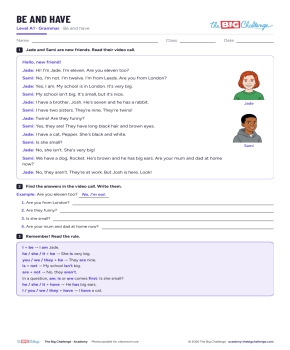
This grammar sheet teaches be (am, is, are), its negatives isn't and aren't, questions with be and their short answers (Yes, I am. / No, she isn't.), and have / has to say what people have. Pupils read a video call between two new friends, Jade from London and Sami from Leeds, then read the rule, given in a box, and use it. By the end, they can say who they are and what they have, correct a wrong sentence and ask and answer simple questions with be.
Pedagogical guide
Page 1 is the video call: Jade and Sami talk about their age, their schools, their families and their pets. Pupils find four short answers in it, then read the rule, given in a box in short lines with the key words in bold. Page 2 practises one form at a time: seven sentences with am, is or are, seven with have or has, six corrections where the next sentence gives the answer ("No! Pepper isn't small. She's very big."), and five sentences to turn into questions by putting is or are first. Page 3 has five questions on the video call with three short answers to choose from, then "Who's who?": pupils read six descriptions with be and have and write the names under eight portraits; two children have no name. Every exercise opens with a worked example. The sheet uses have / has for possession, not have got.
Suggested procedure
- (5 min) Ask a few pupils their name, age and town; write the answers on the board with I'm and I have.
- (8 min) Pupils read the video call in pairs, one as Jade, one as Sami, then write the four short answers.
- (5 min) Read the rule in the box with the class; pupils find examples of it in the text.
- (12 min) Page 2: pupils choose am, is or are, then have or has, then correct the sentences.
- (5 min) Pupils make the five questions; a few read them aloud.
- (5 min) Page 3: pupils tick the short answers.
- (8 min) "Who's who?": pupils read the descriptions and write the names under the pictures.
- (5 min) Check with the answer key on page 4.
Adaptations
[S] Read the video call aloud in pairs before the questions; do "Who's who?" with the class, one description at a time.
[A] Pupils write a description of one of the two children with no name, and a partner finds the picture.
Materials & prerequisites
One copy of pages 1 to 3 per pupil. Page 4 is the answer key and page 5 the teacher notes: keep them. In the corrections, the full forms (is not, are not) are right too. Pupils need the subject pronouns and my, his, her. To take it further, pupils write three sentences about themselves with be and have, and the class guesses who wrote them.