


I'm really sorry!
Academy Access
Your Worksheet
Assess your students' knowledge with this ready-to-use worksheet, designed to reinforce grammar and vocabulary points.
Premium Resource. This tool is part of The Big Challenge Academy. Subscribe for unlimited access to hundreds of premium resources.
Pedagogical Guide
Objective & content
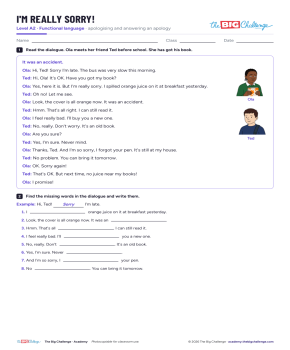
This functional language sheet teaches pupils to say sorry (I'm sorry. I'm really sorry. Sorry I'm late.), to say what happened in the past simple (I spilled orange juice on it. I forgot your pen. It was an accident.), to offer to make it better (I'll buy you a new one. I'll bring it tomorrow.) and to answer an apology kindly (That's all right. Don't worry. Never mind. No problem.). Pupils read a dialogue in which Ola meets her friend Ted before school with the book she borrowed, find the missing words and read the useful phrases, given in a box. By the end, they can apologise, explain what happened and answer a friend who says sorry.
Pedagogical guide
Page 1 is the dialogue, with a picture of Ola and of Ted: Ola is late because the bus was slow, and she spilled orange juice on Ted's book at breakfast yesterday, so the cover is all orange. She offers to buy him a new one, but Ted says it's an old book and he can still read it. She also forgot his pen, and she can bring it tomorrow. Pupils find eight missing words in lines from the dialogue. Page 2 has the useful phrases in a box, with the key words in bold, five situations to match to a phrase (you forgot a friend's comic, it was an accident, you want to give a new pen, you answer kindly, you say you are sure) and six lines with three replies each, where pupils tick the best one. Page 3 has a dialogue in which Mateo meets Effie at the cinema, late and without the tickets, to number from 1 to 7, and a dialogue between a boy and a girl in the school canteen to complete with seven words in a box. The last task is a role-play: pupils cut out cards A and B and work in pairs. Each pupil says sorry for two things, says what happened and offers to make it better, then answers the partner's apologies from the feelings on the card: kindly, or kindly and asking for something. Every exercise opens with a worked example.
Suggested procedure
- (5 min) Drop a pencil next to a pupil and say "Oh, sorry!"; pupils answer "That's OK." or "Don't worry."
- (10 min) Read the dialogue aloud; pupils find the missing words.
- (5 min) Read the useful phrases in the box with the class; pupils find them in the dialogue.
- (10 min) Page 2: pupils match the situations to the phrases, then tick the best replies.
- (10 min) Page 3: pupils number the lines of Mateo and Effie's dialogue, then complete the canteen dialogue.
- (10 min) Role-play: pupils act out the role-play in pairs with cards A and B.
- (5 min) Check with the answer key on page 4.
Adaptations
[S] Pupils read the dialogue aloud in pairs, one as Ola and one as Ted, before the tasks.
[A] Pupils write a short sorry message to a friend: what happened and how they can make it better.
Materials & prerequisites
One copy of pages 1 to 3 per pupil, and scissors for the role-play cards. Page 4 is the answer key and teacher notes: keep it. The role-play is free speaking, so any answer that uses the phrases and fits the card is right. Pupils need the past simple of a few common verbs (spilled, forgot, missed, was) and have got. To take it further, pupils act out a new sorry scene for the class, and the class says which answer was the kindest.