


What should I do?
Academy Access
Your Worksheet
Assess your students' knowledge with this ready-to-use worksheet, designed to reinforce grammar and vocabulary points.
Premium Resource. This tool is part of The Big Challenge Academy. Subscribe for unlimited access to hundreds of premium resources.
Pedagogical Guide
Objective & content
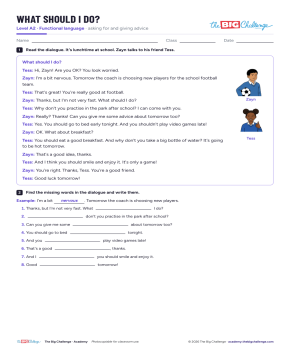
This functional language sheet teaches pupils to ask for advice (What should I do? Can you give me some advice?), give advice (You should go to bed early. You shouldn't play video games late. Why don't you practise in the park? I think you should smile!) and thank someone for it (That's a good idea, thanks. You're right.). Pupils read a dialogue in which Tess gives her friend Zayn advice, find the missing words and read the useful phrases, given in a box. By the end, they can ask for advice, give two pieces of advice with should and shouldn't, and say thank you.
Pedagogical guide
Page 1 is the dialogue, with a picture of Zayn and of Tess: it's lunchtime at school, and Zayn is nervous because tomorrow the coach is choosing new players for the school football team. Tess tells him to practise in the park after school, go to bed early, not play video games late, eat a good breakfast, take a big bottle of water because it's going to be hot, and smile and enjoy it. Pupils find eight missing words in lines from the dialogue. Page 2 has the useful phrases in a box, with the key words in bold and should / shouldn't + a verb, five situations to match to a phrase (a cold, maths homework, a thank you, asking for advice, a tennis match) and six lines with three replies each, where pupils tick the best one. Page 3 has a dialogue in which Kit gives Remi advice before his first week at a new school, to number from 1 to 8, and a dialogue about a maths test to complete with six words in a box. The last task is a role-play: pupils cut out cards A and B, each with three small problems (a test, being tired at school, a swimming race, a birthday present, the guitar...). They take turns: one tells a problem and asks for advice, the other gives two pieces of advice. Every exercise opens with a worked example.
Suggested procedure
- (5 min) Say "I'm always tired in the morning. What should I do?"; pupils answer "You should go to bed early."
- (10 min) Read the dialogue aloud; pupils find the missing words.
- (5 min) Read the useful phrases in the box with the class; pupils find them in the dialogue.
- (10 min) Page 2: pupils match the situations to the phrases, then tick the best replies.
- (10 min) Page 3: pupils number the lines of Kit and Remi's dialogue, then complete the second dialogue.
- (10 min) Role-play: pupils read their problems, then take turns to ask for and give advice.
- (5 min) Check with the answer key on page 4.
Adaptations
[S] Pupils read the dialogue aloud in pairs, one as Zayn and one as Tess, before the tasks.
[A] Pupils write one problem on a piece of paper; the class reads them and writes advice under each one.
Materials & prerequisites
One copy of pages 1 to 3 per pupil, and scissors for the role-play cards. Page 4 is the answer key and teacher notes: keep it. The role-play is free speaking, so any advice that uses the phrases and fits the problem is right. Pupils need have got (I've got a test), can and the words for school and free time. To take it further, make an "advice wall" for pupils who are new at the school.